Sand is the engine of Vietnam’s economic development. Without it, highways cannot be built, cities cannot grow, and climate adaptation infrastructure stalls. For decades, that sand has come from rivers, but excessive extraction has taken a serious toll on riverbeds, riverbanks and delta ecosystems. Through IPDC, Vietnam and the Netherlands developed the country’s first technical guidelines for offshore sand extraction – giving authorities and companies a responsible framework for extracting sand from the sea.
The project was led by the Vietnamese Department of Geology and Minerals (VDGM), in collaboration with IPDC partners Deltares, the Netherlands Commission for Environmental Assessment (NCEA) and Port Consultants Rotterdam. A broad range of Vietnamese government departments contributed, including the Department for Environmental Protection, the Department of Sea and Island, Federation of Marine Geology and Minerals, Federation of Physical Geology – alongside the Institute for Geology and the Hanoi University of Geology and Mining and the International Association of Dredging Companies (IADC).
Running out of options
Vietnam is among the world’s most climate-vulnerable countries. Sea level rise, shifting rainfall patterns and more frequent extreme weather events are placing its coastal and delta regions under growing pressure. Rapid urbanisation has added to that challenge, driving significant demand for construction materials. Sand is chief among them and has long been sourced from the delta country’s rivers.
Offshore sand extraction – extracting sand from the seabed – can offer a more sustainable way to meet that demand. But while Vietnam has legislation covering marine mineral extraction, it lacks specific guidelines for marine sand extraction. There are no technical criteria, no clear permitting procedure, and limited institutional experience. An official receiving a permit application for marine sand extraction today has no clear procedure to follow, and a company wishing to operate has no framework to work within.
Starting from scratch
Developing guidelines for a sector that barely exists in Vietnam meant beginning almost from zero. The project started with a comprehensive review of legal frameworks and technical practices in both countries. Dutch experts examined what makes the Netherlands’ approach to offshore sand extraction effective, while Vietnamese partners mapped what existed domestically. In the absence of offshore experience, they drew on data and procedures from river extraction.
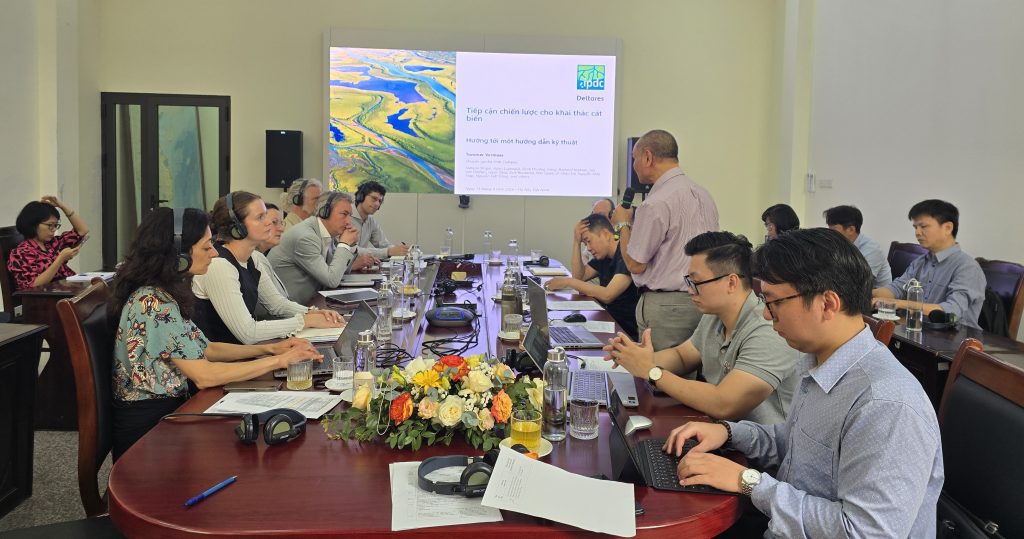
A week-long visit to Vietnam brought the two teams together, along with officials from the Ministry of Agriculture and Environment and the Vietnamese Department of Geology and Minerals. The team also tracked down the handful of people involved in Vietnam’s two pilot projects and interviewed them directly. Despite lacking experience in offshore extraction, the process revealed that the Vietnamese team has a solid understanding of both the regulatory framework and the technical aspects of sand extraction. This proved to be a solid foundation for shaping the guidelines.
Filling the gaps
Rather than producing a comprehensive set of guidelines from scratch, the project focused on the gaps in Vietnamese knowledge and practice of what responsible offshore sand extraction requires. These included environmental impact assessment, location selection criteria, zoning rules that define how close to shore extraction can take place, and dredging technology. That last gap proved particularly significant: Vietnam currently lacks the specialised vessels needed for deep offshore extraction. Interestingly, the country does have shipyards capable of building them, and already delivers dredging vessels to the Netherlands. A clear legal and regulatory framework is expected to trigger a supply chain for dredging vessel manufactory industry in Vietnam as well.
The resulting guidelines cover the full lifecycle of an offshore sand extraction project – from location assessment and permitting, through extraction, to post-extraction monitoring. This means companies and investors entering this new sector have a clear framework to operate within, while authorities responsible for granting and overseeing permits have the criteria they need to do so responsibly.
From guidelines to a new sector
The guidelines were completed and delivered to the Vietnamese Ministry of Agriculture and Environment in May 2026. Once formally adopted as a legal instrument, offshore sand extraction will become a regulated, permitted activity in Vietnam for the first time.
The implications reach far beyond regulation, indirectly impacting the country’s infrastructure, climate resilience and livelihoods.
“Sand is like the engine for economic development. If you lack sand, you cannot move forward. By developing marine sand extraction as a sustainable and regulated alternative, Vietnam can secure the resources it needs for infrastructure and climate adaptation – while protecting the rivers and delta ecosystems that communities depend on.” – Trang Dinh Phuong, IPDC country coordinator for Vietnam and project lead
A model for other delta nations
Developing guidelines for a sector with almost no local data or precedent is precisely the kind of challenge where international knowledge exchange proves its value. The structured approach taken here – mapping gaps, combining Dutch expertise with Vietnamese institutional knowledge, and co-creating solutions – offers a practical model for other delta and coastal nations facing similar pressures. For countries where river systems are under stress and marine alternatives are still untested, Vietnam’s experience offers a concrete starting point.
Want to know more about IPDC’s work in Vietnam? Get in touch with Trang Dinh Phuong at Trang.Dinh@deltares.nl or Natalia Strigin at Natalia.Strigin@deltares.nl.