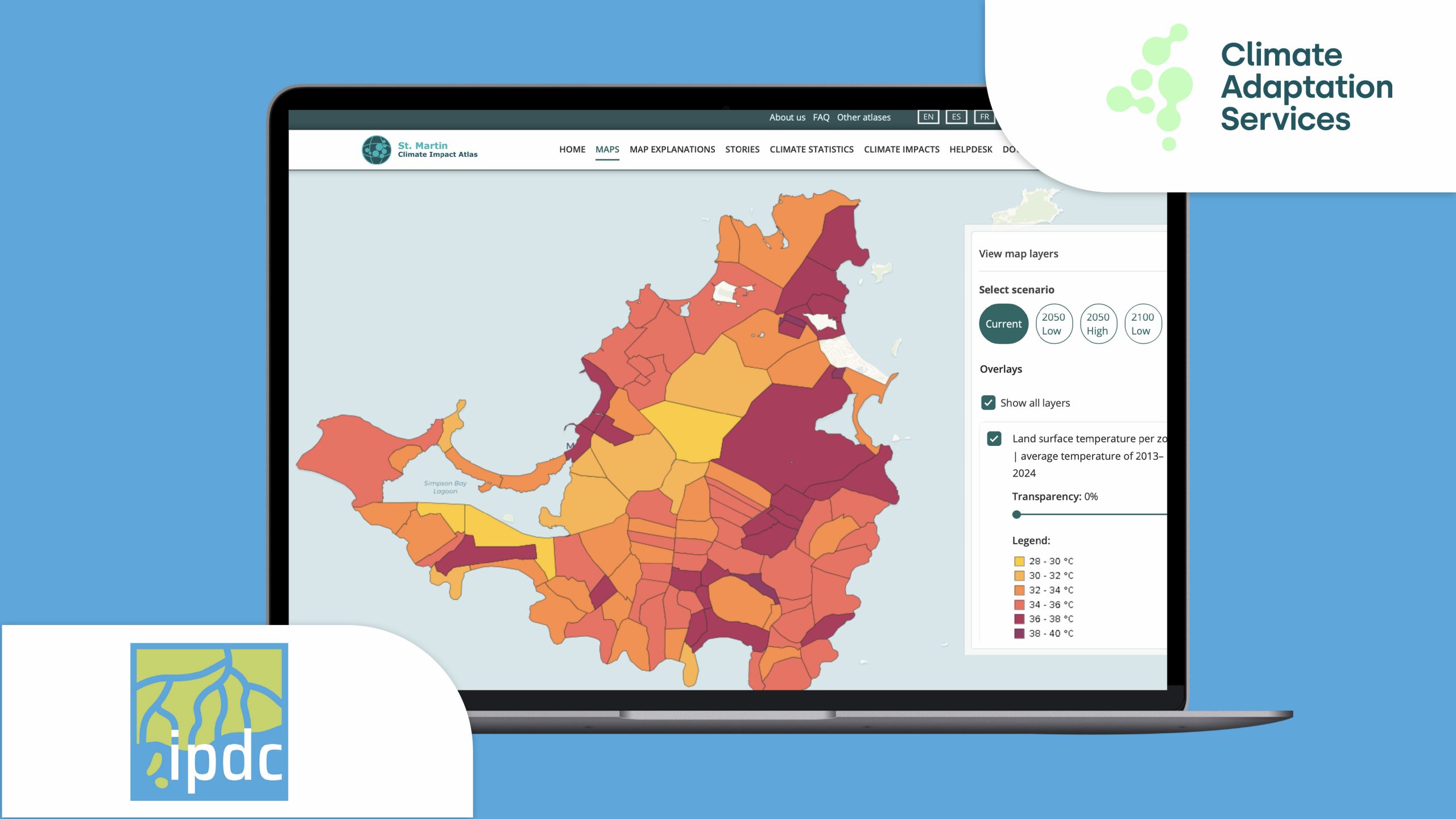
The Dutch Caribbean islands are vulnerable to the effects of climate change. Building resilience is key to tackling these challenges. Spanning across Aruba, Curaçao and St. Maarten, the IPDC project ‘Climate scenarios and digitisation’ aims to deliver selected climate change scenarios for 2050-2100 and digitised historical meteorological data.
In recent decades, the world has experienced significant changes in global mean temperatures driven by increased greenhouse gas emissions. This global climate change has started to impact populations worldwide, including those on small islands such as Aruba, Curaçao, and Sint Maarten. As a result, understanding what further climate change may be expected in the remainder of this century is crucial.
The IPDC has worked with a range of partners to deliver selected climate change scenarios for 2050-2100, and to digitise meteorological archives. This ultimately helps increase public awareness, and to inform or enhance national climate risks assessments and national adaptation strategies and plans.
Climate scenarios
Climate scenarios were developed for the periods 2050-2100. They were tailored to the local circumstances of the islands of Aruba, Curaçao and Sint Maarten. The scenarios entail projections for climate stressors such as temperature, windspeed, rainfall and sea water level. Due to uncertainty in future changes to the global climate, the scenarios present possible outcomes based on key assumptions for global emissions (for example: low, mid and high global emissions) and for regional rainfall (such as a ‘dry vs. wet’ future). This means six climate scenarios have been developed for each island. Whereas no probability is assigned to each scenario, the output range provides valuables insights into the possible effects of climate change and helps decision-makers explore different future conditions before they choose measures or investments.
The climate scenarios are based on scientific evidence and consist of both a technical report and a user report that is written in a clear and accessible way so a wider audience can understand the main outcomes. They serve to inspire the design of climate adaptation measures and are being used in the development of National climate Adaptation Strategies for Aruba, Curaçao and Sint Maarten. Moreover, the output range illustrates the relevance for small islands such as Aruba, Curaçao, and Sint Maarten of limiting greenhouse gas emissions at the global level.
Digitisation
Meteorological archives contain a wealth of information on historical weather patterns specific to local geographies. Although such historic information is immensely valuable for analysis and input for future climate change predictions, it is (often) contained in historical paper records which cannot be readily imported into computer programs. Moreover, historical archives are at risk from calamities such as fire or extreme weather events.
To make the information accessible, the project involved imaging, digitising and safely storing the meteorological data from historical archives.
In addition to digitising local data, the project worked with Government of Curaçao to ensure the availability of the meteorological archive of the former Netherlands Antilles.
Access to this historical information unlocks a wealth of insights on weather patterns in each of these islands as input for future climate scenario enhancement.
Capacity Building
The project also aims to support and enhance the capacity of the meteorological offices for Aruba, Curaçao, and Sint Maarten. Support allows these meteorological offices to develop and communicate the climate scenarios for their respective islands.
Each participating country will take part in a specifically-tailored capacity-building workshop. Workshops will also be organised at each of the meteorological offices on Aruba, Curaçao, and Sint Maarten, providing training on digitisation techniques and data management practices.
Partners
The IPDC worked closely with stakeholders across the Dutch Caribbean and in the Netherlands to realise the project. Partners include the governments of Aruba, Curaçao, and Sint Maarten, the Departamento Meteorlogico Aruba (DMA), the Meteorological Department Curaçao (MDC), Meteorological Department St. Maarten (MDS), and the Royal Netherlands Meteorological Institute (KNMI).
The development of the climate scenarios was built on the KNMI’s 2023 national climate scenarios for the Netherlands. This included similar scenarios developed for the Dutch municipalities of Bonaire, St. Eustatius, and Saba. The joint project partners express their gratitude to the Government of the Netherlands for making this work possible through the IPDC programme.
Resources
· User report on climate scenarios for Aruba
· User report on climate scenarios for Curaçao
· User report on climate scenarios for St. Maarten
· Technical (scientific) report on climate scenarios for Aruba, Curaçao and Sint Maarten.