The latest IPDC online session brought together experts to discuss the Coastal Hazard Wheel (CHW), a universal framework that supports coastal classification and hazard management worldwide. Speakers shared insights on the development of the methodology and the tool, its practical use across countries, and lessons from national applications.
Watch the recording of the session here:
The Coastal Hazard Wheel as a universal framework
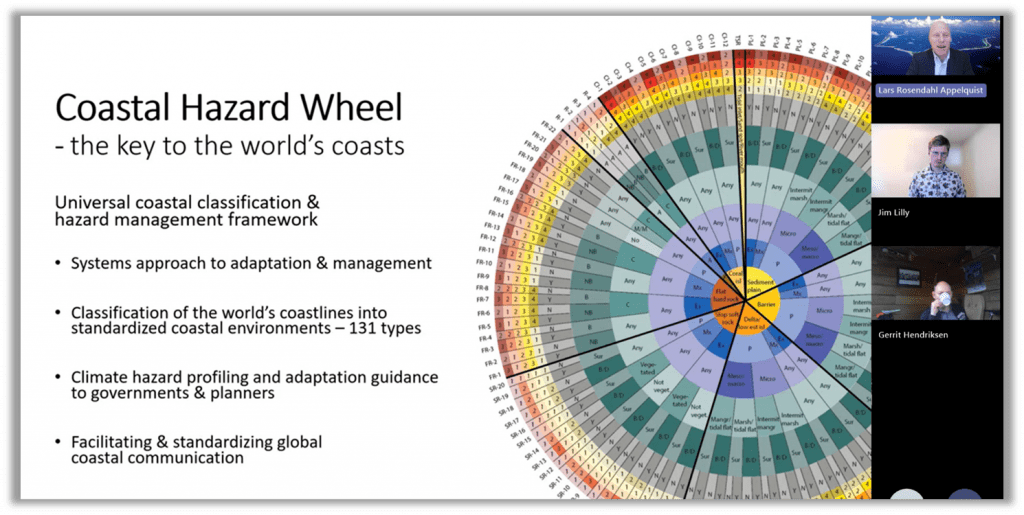
Lars Rosendahl Appelquist introduced the CHW as a response to persistent challenges in coastal management, such as fragmented understanding of coastal systems, communication barriers between science and policy, and limited integration of multiple hazards. The framework consists of six classification layers and five hazard layers, covering 131 generic coastal environments that together form the Wheel. These environments are represented through codes that help identify comparable coastal systems and potential adaptation options.
Common coastal types among Small Island Developing States include sloping hard rock coasts with or without corals, flat hard rock systems influenced by tropical cyclones, coral islands with stable sediment balance, and mangrove‑dominated flat coasts. When combined with projected hazard exposure, the wheel offers a first insight into suitable adaptation measures. Developed through an open‑access partnership between Deltares, UNEP centres, and the University of Copenhagen, the framework is now used in many world regions.
From framework to practice
Gerrit Hendriksen introduced a global applicable spatial web version of the Coastal Hazard Wheel methodology and highlighted the importance of open‑source principles and global consistency that form the base of the tool. Collecting global datasets required extensive work, including digitizing deltas. Making use of the global data introduced various technical challenges that need to be incorporated in components to identify barrier and sandspit. The Coastal Hazard Wheel App now allows users to explore any coastline globally and access CHW‑based information. The tool is primarily intended for first assessments rather than detailed scientific analysis. From the lessons learned from national applications, the tool does not recognize local variations in coastal management, such as groines or other ‘hard engineering constructions’.
Lessons from national applications
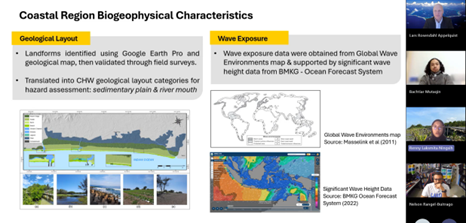
Speakers from Indonesia and Colombia shared experiences applying the CHW in diverse settings. In Indonesia, the tool was chosen because it integrates multiple hazards and provides a universal classification language. However, local validation remains essential. Users must add socioeconomic information themselves and rely on local expertise to avoid misclassification. Despite its limitations, the CHW is valued for communicating risks clearly to policymakers and non‑specialists.
Testing the tool in Kulon Progo, Indonesia, showed that it supports early identification of priority hazard zones and can guide spatial planning. The speakers recommended combining the CHW with quantitative modeling and multi‑hazard maps for detailed planning. The framework does not include hazard frequencies or intensities and provides limited spatial detail.
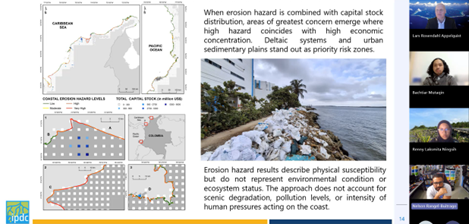
In Colombia, the tool revealed that the Caribbean coast faces the highest erosion hazard, especially in deltaic systems, urbanized sedimentary plains, and mangrove‑dominated areas. The Pacific coast shows lower erosion levels. Environmental quality assessments helped refine the analysis and identify particularly vulnerable stretches of coastline.
Looking ahead
The session demonstrated that the Coastal Hazard Wheel is an accessible and scalable starting point for coastal adaptation planning. While it cannot replace detailed analyses and misses local information, it supports early screening, risk communication, and stakeholder engagement, especially in data‑limited regions. The IPDC will continue to collaborate with partners to strengthen coastal resilience through the use of tools like the CHW.